The Flicking Frog
A small frog using a soft-robotic actuator tongue to flick flies into its mouth.
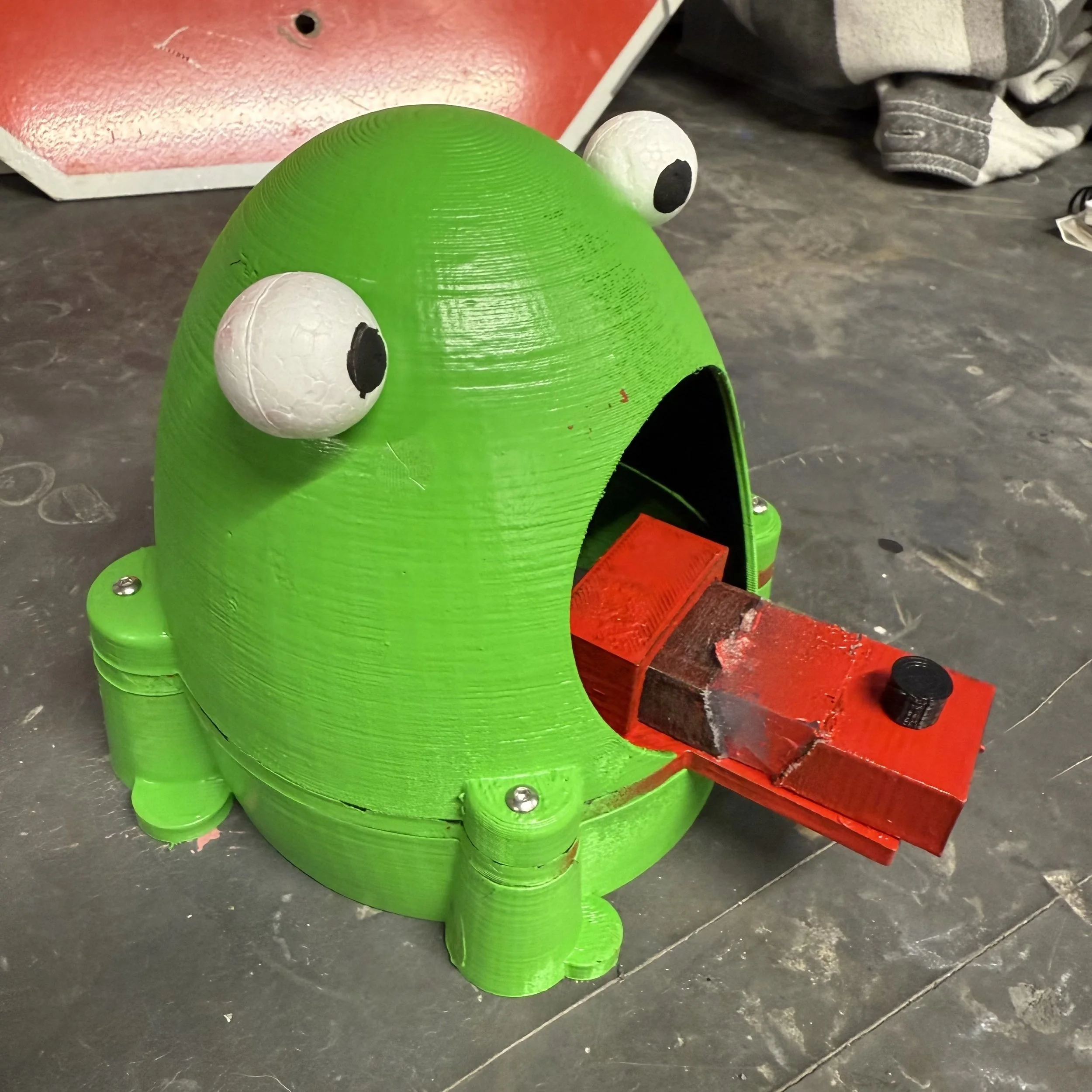
Background and Motivation
This project was made for a creative soft-robotics course. The overall objective of this course was to use recent soft robotic developments to make an interactive art piece. The course was structured as a number of literature reviews, with some hands-on lessons in common fabrication methods common in soft-robotics. This included casting silicone and 3D printing. This was followed by a few weeks of design and prototyping, which led into the creation of the final product.
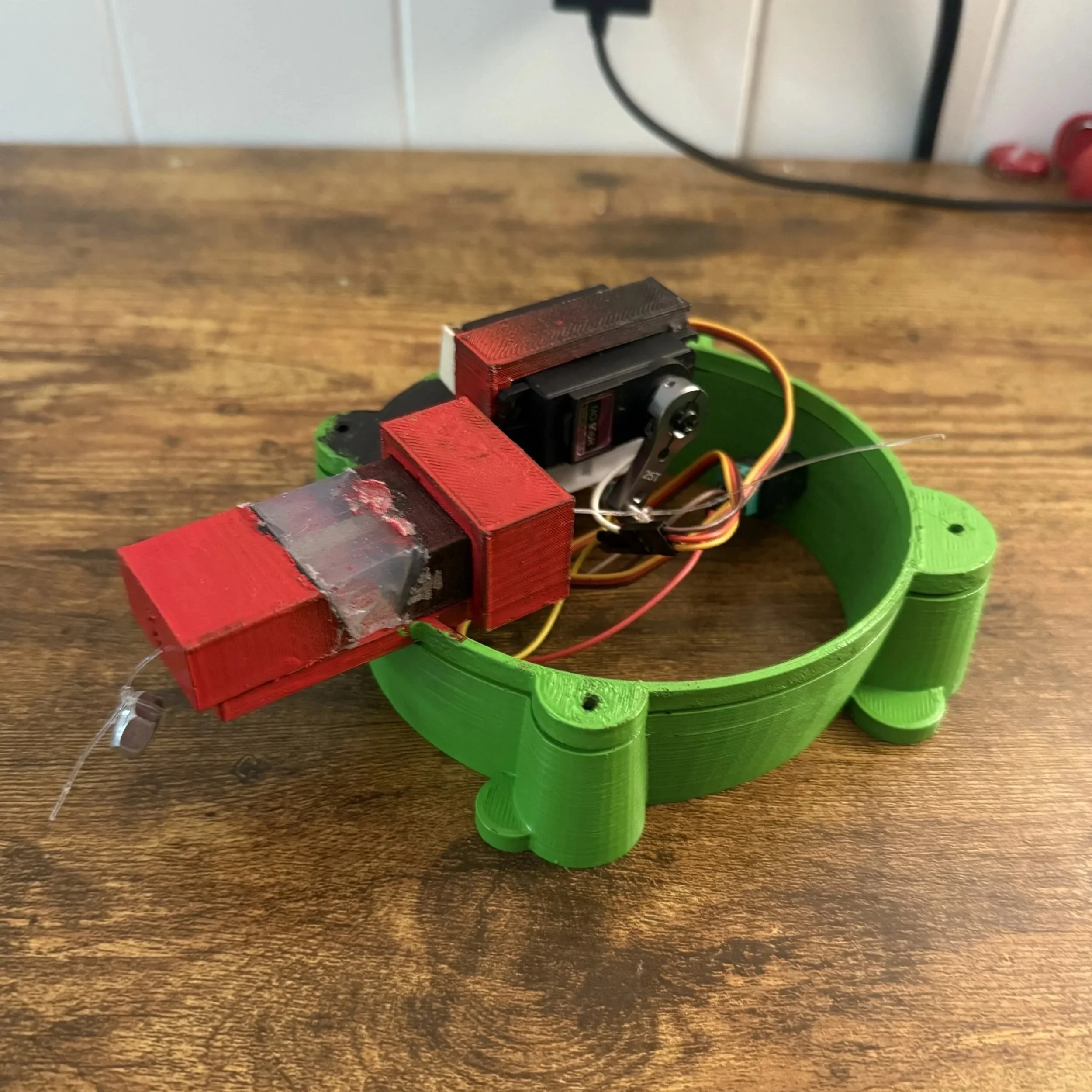
The soft robotic actuation I chose to use was a “Hyper-elastic Torque Reversal Mechanism" with “transient bi-stability.” Essentially, this mechanism had two rigid pieces with a wedge shaped silicone portion in between. Through the middle of this stack is an asymmetric channel with a filament running through it. As the filament is pulled the elastic portion compresses building tension. After a certain amount of tension is build up, the filament moves over the center line of the channel causing the tension to suddenly be released and the actuator flicks. Depending on how the filament is pulled, when and how the flick occurs can be adjusted. This is explained in the original paper in much greater detail. (HERE)
Design and Testing
Prototyping was essentially a game of trial and error. The original paper used materials and techniques that I simply did not have access to, which made replicating their work a challenge. I made about a dozen different variations of the actuator, using different proportions, sizes, and silicone stiffnesses. The original paper used a circular cross section, while I used rectangular ones for easier and more reliable manufacturing, which added to the challenge of matching the paper’s results.
The design followed the prototyping fairly closely. Once an acceptable actuator was found, the support for it and a drive servo was designed around it. The frog body was designed around that support piece. The support piece, the frog body, and the rigid parts of the actuator were 3D printed. The silicone was cast then epoxied into place. The servo’s power and control came from a Arduino nano, tucked inside the body.
Ultimately this design did work, but it required design modifications to make the behavior more repeatable. I added a back-stop, which forced the actuator to in a straight line and prevent it from locking out in the wrong direction. Additionally, instead of using a spool to wind in the filament, I simply attached the filament to a servo arm, allowing the arc to help the actuator to move over center.